Store garden seeds through winter without losing the record.
Keep seeds dry, cool, dark, labeled, and protected from temperature swings. The goal is one trustworthy seed jar—not a drawer of mystery packets.
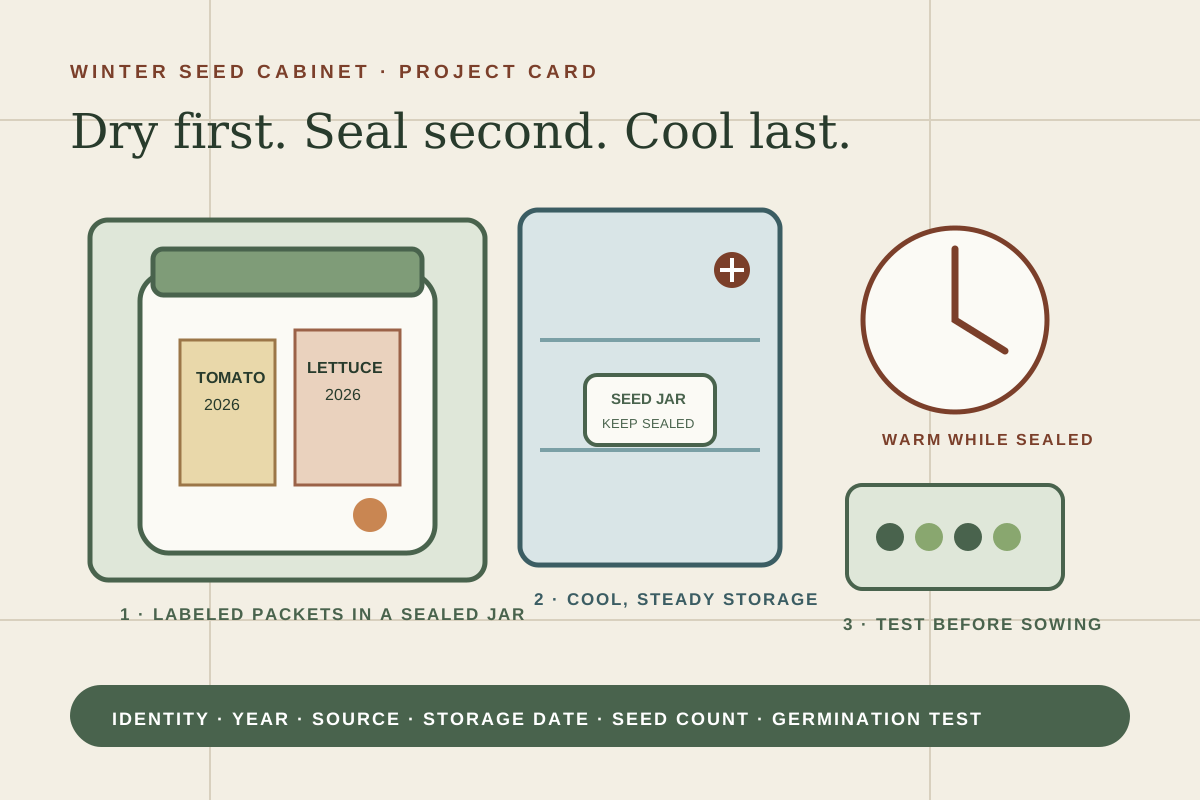
Late fall is a good time to close the loop on a small garden. Leftover commercial seed, carefully saved seed, and half-labeled envelopes have all reached the same decision point: keep, test, share, or discard. A reliable storage system protects two things at once—the seed's ability to germinate and the information needed to plant it well.
The storage principles are simple. Colorado State University Extension identifies seed moisture and temperature as the main factors in storage life. Oregon State and University of Minnesota Extension both recommend cool, dry storage in labeled packets inside tightly sealed containers. The practical work is deciding which seed belongs in that system and preventing cold storage from adding condensation.
Begin with four separate seed groups
Do not pour every packet into one pile. Source and history affect what the label needs to say and how much confidence you can place in the seed.
Keep the original commercial packet whenever possible. It carries sowing depth, spacing, germination needs, treatment statements, lot information, and the variety name. Put a torn packet inside a larger paper envelope rather than recopying only the crop name.
Home-saved seed needs a stronger record because there is no manufacturer packet to consult. Write the crop, variety, harvest year, location, and whether the plant was known to be open-pollinated or hybrid. University of Minnesota and Oregon State Extension explain that many hybrids will not produce offspring true to the parent and that cross-pollinating crops may require isolation. Storage can preserve a seed without preserving the traits you expect.
Do not save seed from plants with unexplained disease symptoms merely because the fruit or pod reached maturity. Some pathogens can move on seed; University of Minnesota specifically notes bacterial canker risk with infected tomato seed or transplants. Ask a local Extension diagnostic service about the crop and symptoms instead of treating dry storage as sanitation.
Drying and storage are different jobs
Seed collected from the garden must be mature, cleaned, and properly dried before it enters a sealed container. Sealing seed that still carries excess moisture can trap the very condition the system is meant to exclude. Follow crop-specific harvesting and drying guidance: fleshy fruits such as tomatoes use a different process from dry bean pods, lettuce heads, peppers, or flowers.
Oregon State advises finishing dry seed with good air circulation and warns that damage begins when seed temperatures rise above 95°F. Colorado State cautions against microwave drying and notes that beans and peas can become hard seed if they are overdried. These details are why a universal oven, dehydrator, or “snap test” should not replace a crop-specific Extension method.
Commercial leftover seed is already prepared for storage, but an opened packet can still pick up room moisture. Close it promptly after sowing. Keep it away from potting benches, greenhouse mist, kitchen steam, and wet gloves before it returns to the storage container.
Use a packet inside a container
The paper packet and the outer container do different jobs. Paper keeps small lots separated and writable. The outer container limits moisture exchange and protects against spills, pests, and household humidity.
- Label the inner packet. Include crop, variety, source, harvest or packed-for year, date stored, and any treatment or uncertainty. Use an archival pencil or ink that will remain legible in the expected conditions.
- Group without mixing. Several paper packets can share one tightly sealed glass jar or suitable moisture-proof container. Never combine loose varieties merely to save space.
- Add a supported desiccant only when needed. University of Minnesota describes silica gel or a small wrapped amount of freshly opened powdered milk. Oregon State also describes silica gel. Keep any desiccant physically separated, labeled, intact, and unavailable to children or pets.
- Close the container fully. A refrigerator is humid. A loose lid or casual paper box does not protect dry seed from that air.
- Label the outside. Write the contents, storage date, and “warm sealed before opening” where everyone using the refrigerator can see it.
Do not assume dry rice is an equivalent desiccant because it appears in a social post. Use a material and amount supported by current Extension guidance, and do not let powder or beads mix with seed. Replace or recharge a product only according to its instructions.
Choose the most stable cool place you have
Cool, dry, and dark matter more than buying a special organizer. For seed intended for next season, a consistently cool interior cupboard may be adequate. Colorado State says vegetable and flower seed can generally keep for a year at room temperature without a significant loss in germination under its stated conditions. Hot apartments, humid basements, laundry rooms, and sunlit shelves can be much less forgiving.
A refrigerator can extend storage life when the seed is dry and the container is truly sealed. University of Minnesota gives an ideal range of 32–41°F, while Colorado State describes good storage below 40°F. Use a shelf where temperature stays steady and the jar will not be pushed against a wet back wall or mistaken for food.
A garage, vehicle, balcony cabinet, greenhouse, or shed is not automatically “cool.” Sun and seasonal swings can make those places very hot, and leaks or condensation can make them damp. Measure the conditions across several days if you are considering an unconditioned space. Rodent and insect access also count.
Freezing is a long-term option in some Extension guidance, but only for appropriately dry seed in a moisture-proof container. It is unnecessary for a one-season plan and can add risk when seed moisture or the freezer's stability is unknown. Start with the simplest system you can operate correctly.
Prevent condensation when the jar comes out
This is the step many storage diagrams leave out. A cold jar opened in warm, humid air can allow condensation to form on the container or seed packets. South Dakota State University Extension advises letting a refrigerated container reach room temperature before opening it.
- Remove only the sealed container you need.
- Set it in a dry indoor place away from sun, steam, and splashes.
- Leave it closed until the container and contents have reached room temperature.
- Open, remove the needed packet, and close the container promptly.
- Make sure the packet has not been exposed to moisture before returning the sealed container to storage.
Avoid taking one master jar in and out every few days for winter sowing. A small “current season” packet set can remain in a cool cupboard while long-term extras stay sealed. Fewer temperature cycles and openings make the system easier to control.
Do not confuse storage with stratification
Dry cold storage aims to slow seed aging while keeping the seed dry. Cold stratification is a germination treatment for species that need a period of moist cold to break dormancy. The same refrigerator can be used for both projects, but the containers, moisture, dates, and goals are different.
Never add water to a storage jar because a different species requires stratification. Follow the seed packet or species-specific Extension guidance for temperature, moisture, and duration. Label a stratification container clearly so it cannot be mistaken for dry stored seed or food.
Inventory by plan, not packet count
A compact garden does not benefit from fifty varieties that exceed the available beds, pots, light, water, or attention. Link the seed cabinet to a real space plan.
| Inventory field | What to record | Decision it supports |
|---|---|---|
| Identity | Crop, variety, source, lot if available | Avoid duplicate or mystery seed |
| Age | Packed-for or harvest year | Choose which packet to test or use first |
| Quantity | Approximate seeds or packet fraction | Compare with bed and container space |
| Storage history | Known conditions, date sealed, any moisture event | Decide whether confidence is high or low |
| Planting role | Direct sow, indoor start, succession, backup | Build the sowing calendar |
| Test result | Date, seeds tested, seeds germinated | Buy fresh seed or adjust sowing |
Use the small kitchen garden plan to match seed quantity with sunlight, water, space, season, and what the household eats. This prevents storage from becoming collecting. A packet that does not fit next year's plan can be shared through a local seed library when its identity, age, and rules allow.
Age tables are planning ranges, not promises
Species differ in typical longevity, and storage history matters. Colorado State's reviewed table places onion, parsley, parsnip, and lettuce among shorter-lived vegetable seed, while cucumber, endive, muskmelon, and some other crops can remain viable longer under suitable conditions. Oregon State groups corn, onion, parsley, parsnip, and pepper among shorter-lived seed and tomatoes and cucurbits among longer-lived seed.
Those ranges help set testing priorities; they do not certify a packet. A fresh lot can perform poorly after heat or moisture exposure. An older, well-stored lot can still germinate. Germination percentage and seedling vigor also are not identical: seeds may sprout but produce weaker seedlings.
Run a germination test before the sowing deadline
Test early enough to replace seed without missing the local planting window. Oregon State describes a paper-towel method using 25–50 seeds; a smaller home test can be useful when seed is scarce, but the percentage becomes less precise.
- Check the crop's normal germination temperature, light, and time on the packet or an Extension source.
- Count a known number of seeds. Ten makes the arithmetic easy; 25 or more gives a stronger sample when enough seed is available.
- Place the seeds on evenly moist—not dripping—paper towel and contain them as the crop method requires.
- Keep the test at the correct temperature and inspect on a schedule. Do not declare failure before the crop's expected window ends.
- Count normal seedlings. Divide the number germinated by the number tested and multiply by 100.
If 8 of 10 seeds produce normal seedlings, the observed germination is 80%. If 17 of 25 do, it is 68%. Record the test date and conditions. A low result may justify fresh seed, a higher sowing rate, or using the packet for a low-risk experiment. Do not let a countertop test delay a short direct-sowing window.
A one-hour winter seed cabinet
- Gather every seed packet from drawers, tool bags, sheds, and potting shelves.
- Discard empty packets and isolate anything damp, moldy, insect-damaged, or unidentifiable.
- Keep original packets; place torn ones inside larger labeled paper envelopes.
- Add missing variety, source, and year information while it can still be recovered.
- Separate next-season seed from long-term extras and from seed needing a germination test.
- Place dry packets in one clean, dry, tightly sealed container.
- Choose the coolest stable storage place that fits the plan.
- Write a late-winter germination-test date on the garden calendar.
The finished project should be boring in the best way: one labeled container, one inventory page, no loose seeds, no mystery varieties, and a test date before spring decisions become urgent. Pair it with the fall potting-mix sort so seed and growing media enter winter as separate, documented systems.
Questions from the seed shelf
Should I store seed packets in plastic bags?
Paper packets can organize varieties inside a genuinely moisture-resistant outer container. Colorado State prefers sealed cans or jars over plastic bags for moisture-proof storage. A thin bag alone may not provide the barrier or puncture resistance you expect.
Can I keep seeds above the refrigerator?
Usually that location is warm and can fluctuate when the appliance runs. Choose a cooler, stable interior location or a properly sealed container inside the refrigerator.
Should I save seed from grocery-store produce?
The variety, hybrid status, growing conditions, and disease history may be unknown, so the result may not match the fruit. Begin with clearly identified open-pollinated plants and crop-specific Extension guidance if learning seed saving is the goal.
Can old seed go into a community seed library?
Follow the library's acceptance rules. Disclose crop, variety, source, year, storage history, hybrid or open-pollinated status, and test result. Do not distribute diseased, treated, invasive, mislabeled, or legally restricted seed.
Sources
Reviewed October 27, 2026. Local climate, species, disease, and seed-library rules should shape the final plan.
- Colorado State University Extension — Storing Vegetable and Flower Seeds.
- University of Minnesota Extension — Saving Vegetable Seeds.
- Oregon State University Extension — A Step-by-Step Guide to Saving Seeds.
- Oregon State University Extension — Save Seeds Now for Next Year's Garden.
- South Dakota State University Extension — How to Store Leftover Garden Seeds.
- Utah State University Extension — Collecting and Storing Seeds from Your Garden.
Public discussions were reviewed to identify recurring questions about refrigerator humidity, condensation, garage storage, desiccants, repeated temperature cycling, old packets, and germination testing. The storage and testing guidance above comes from the cited Extension sources.